


Overview
Hop is a purpose-built cross-chain bridge protocol focused on enabling fast, secure, and cost-effective token transfers across Ethereum Layer-2 networks and Ethereum mainnet. Launched to address user pain points around slow finalization times, high gas fees, and centralized intermediaries, Hop leverages a combination of smart contract design and liquidity strategies to provide instant or near-instant settlement experiences without relying on a single validator set.
Core Capabilities
-
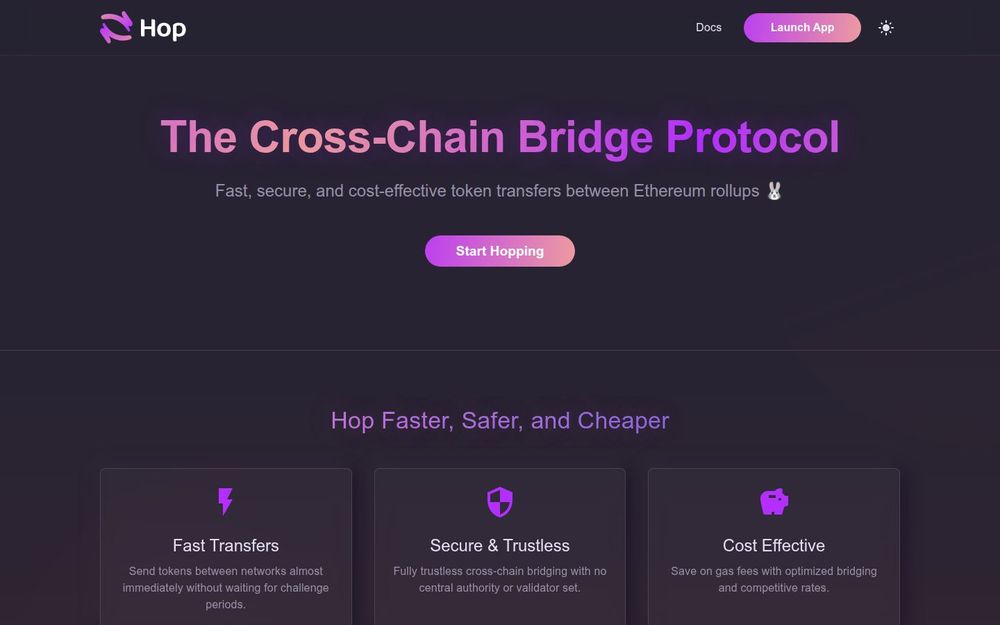
1. Fast Transfers: Hop minimizes waiting times by enabling almost immediate transfers between supported networks, removing long challenge delays that typically accompany cross-chain operations.
-
2. Secure & Trustless Architecture: The protocol is designed to operate without a central authority or trusted validator set, emphasizing cryptographic security and on-chain guarantees to preserve the integrity of cross-chain transfers.
-
3. Cost Effectiveness: Hop reduces transaction costs through optimized bridging paths and competitive rate settings, and by leveraging L2 economies to keep gas consumption and fees lower than direct mainnet bridging.
-
4. Multi-Network Support: Hop supports a broad set of Ethereum Layer-2 networks such as Optimism, Arbitrum One, Arbitrum Nova, Polygon PoS, Polygon zkEVM, Base, Gnosis, and Linea, enabling users to hop assets across numerous ecosystems.
-
5. Developer Tools & SDK: The JavaScript Hop SDK simplifies integration, allowing developers to programmatically initiate cross-chain transfers and incorporate Hop’s bridging mechanics directly into web3 applications.
How Hop Works (High Level)
Hop uses liquidity pools and bridging contracts to facilitate token movements between networks. Rather than waiting for slow canonical finality across chains, Hop lets a liquidity provider or pool front the transfer on the destination network and reconciles balances later through on-chain settlement primitives. This design delivers the user experience of instant transfers while maintaining cryptographic accountability and avoiding centralized custody.
Supported Tokens and Networks
Hop supports many of the most commonly used tokens in the Ethereum ecosystem, including ETH, USDC, USDT, DAI, rETH, MATIC, MAGIC, SNX, and sUSD. On the network side, Hop targets major L2s and sidechains to maximize interoperability and utility, enabling users to move assets across Optimism, Arbitrum, Polygon variants, Base, Gnosis, Linea, and other supported chains.
Developer Experience and Integration
Developers can integrate Hop via the official JavaScript SDK with minimal code. Typical usage involves instantiating the Hop client, connecting a signer, selecting a bridge for a token, and sending the transfer from one network to another. Documentation, example code snippets, and SDK references are provided in the project’s docs and whitepapers to help teams deploy reliable bridging flows quickly.
Security, Transparency, and Community
Hop emphasizes trustless operations, open-source tooling, and transparent protocol documentation. It provides whitepapers and public repositories, an explorer for tracking activity, and active community channels like Discord and a forum for developer support and governance discussions. These resources help users and integrators verify protocol behavior and participate in ecosystem growth.
Why Use Hop
Hop is recommended for users and developers seeking a pragmatic combination of speed, security, and cost savings for cross-chain transfers. Its liquidity-backed transfer model and broad L2 coverage make it a strong choice for applications that need near-instant settlement while preserving on-chain settlement guarantees and developer-friendly integrations.
Recommended Next Steps
- Review Hop’s documentation and whitepapers to understand the protocol design and security assumptions.
- Test the JavaScript SDK in a development environment and experiment with supported token bridges.
- Join community channels for support, updates, and ecosystem collaboration.
Using Hop can streamline cross-chain flows for both end users and application builders who value speed and trustless settlement across multiple Ethereum scaling networks.


